Looking to history for similar situations
Years ago, one of the most intimidating, giant, and highly skilled players, an MVP and statistical monster, missed the playoffs in two straight seasons during his prime, even while playing heavy minutes. The conventional wisdom has always been that you cannot be a superstar if you fail to lead your team to the extra-season, but he broke those rules and caused people to question either how good he was or how we perceived team success. It was difficult to argue what more he could have done because he filled up the stat-sheet in numerous categories with gargantuan numbers. Was he not a leader? Was he only playing for his own stats? Later, when paired with better players, he coincidentally won a championship and the critiques faded away; he was now a "winner."
Today, that player, Kareem Abdul-Jabbar, is regarded as one of the best players of all-time. The consensus is that he's at least the third best player ever and maybe even higher. Media figures like to use the line "you can't be a star if you can't lead your team to the playoffs," including Bill Simmons, who said back in 2006 said, "Can you name another alleged "superstar in his prime" who missed the playoffs for two straight seasons?" Somehow he missed Kareem, and this is a guy who watched Kareem in person back in the 70's and wrote a book on the history of the league.
And it's not just Kareem. Barkley missed the playoffs in 1988 and won only 36 games, while repeating the feat in 1992 with 35 wins before being traded to a better team the next season, where he immediately went to the finals (that should sound familiar.) Moses Malone, loved by the old-guard and the mainstream media, missed the playoffs in 1978 and won 41 and 40 games, respectively, in 1980 and 1981, though he still managed to pick up three MVPs between 1979 and 1983. He also joined a talented 76ers team with a superstar in Dr. J along with a great supporting cast in Bobby Jones and Mo Cheeks, among others, and they had been going deep in the playoffs every season, including three finals appearances in the six seasons before Moses.
Kobe missed the playoffs in 2005 after Shaq left and nearly missed again in 2006; the 2014 Wolves may actually match their win total but could miss out due to the abnormally strong western conference. Olajuwon had four straight seasons of mediocre 40 to 46 win teams while he was in his 20's, but always gained entry to the playoffs due to the weak conference at the time, except later in 1992 when, in the prime of his career at age 29, they managed a meek 42 wins.
Some of the greatest players of all-time have either missed the playoffs in their prime or failed to clear the 0.500 Mendoza line. If even the best players ever near the top of their games can't push every team they have past 45 wins or worse, then why can't Kevin Love be an elite player when they're on pace for 40 to 42 wins with a point differential that suggests an even stronger team? People will cite how he's never been to the playoffs and will even include his 2013 injury-plagued season, but they fail to study the context, which is especially relevant for one of the most incompetent franchises in the modern era.
But the most similar case, arguably, happened with the same franchise less then ten years ago and they, oddly enough, share the same first name. Kevin Garnett missed three straight playoffs while averaging 22 points, 13 rebounds, 5 assists, 1.5 steals, and 1.4 blocks a game. In fact, Garnett's only one of five players in NBA/ABA history who have led their teams in total points/rebounds/assists/blocks/steals, and he narrowly missed the feat (by only six blocks) in 2005. He also missed the feat in 2006 by a measly four steals. He missed the playoffs, but what more could he have done as the leading scorer, passer, rebounder, and defender?
If you thought Garnett was just a "good stats on a bad team" player, then the ultimate test would be to put him on a team with good players and a good coach, and, obviously, that's exactly what happened. The result, even though Garnett was a little past his prime? A dominating season with one of the best modern defenses of all-time, and a championship that included several lopsided wins. (People cite their losses, but overall a point differential of 5.2 is very strong even for a title team. Hollinger rated it as the 10th best finals team in league history in 2011.)
We've had a prime example of a power forward named Kevin putting up monster numbers for a non-playoff team where people feared he really wasn't a winner, and it was thoroughly refuted, proving that a more comprehensive and thoughtful analysis is needed than "his team didn't go to the playoffs."
Kevin Love's incredible season
People generally rate players based on their basic box score averages, however flawed that is. He excels here since he does pretty much everything on offense, including things not captured by basic stats, and he remains one of the best rebounders in the league.
25.6 points, 13.3 rebounds, 4.0 assists.
The list of people who have matched those averages is extremely short. Only Wilt Chamberlain, Elgin Baylor, Billy Cunningham, and Kareem Abdul-Jabbar have averaged at least 25 points, 13 rebounds, and 4 assists a game. And those seasons were aided by the high pace of the early NBA, inflating rebound totals and other stats. In fact, looking at per possession stats, no one else matches Love's combination of high volume, high efficiency scoring, elite rebounding, and great passing: a usage of at least 28, a TS% above 58, a rebound rate above 19, and an assist rate above 19 (via basketball-reference.) Relaxing the thresholds to a usage of at least 27 (remember league average is 20, and the league leader is typically a little over 30), a TS% of 56 (above league average comfortably), a rebound rate of 18 (still elite, especially for a high scorer), and an assist rate above 17 (assisting on 17% of his teammate's field goals), there are a handful of seasons that qualify since turnovers were first tracked: Kareem in '78, Barkley in '95 and '96, Shaq in '00 and '01, Duncan in '02, '03 and '07, Garnett in '04, and now Kevin Love in '14. That's a list of some of the greatest, well-rounded big men in league history, and Kevin Love is among them. These "one of X players to average this" lists can be arbitrary, but those are all important stats and the standards were relaxed significantly under what Love is doing now.
People counter that Love's points come from "garbage" plays and he only scores in situations like an offensive rebound put-back. It's frustrating to hear that criticism because this is an era where we have an dizzying array of stats and video available. Then there's something basic like his offensive rebounding numbers this year have been low, under 10%, partly due to all his outside shots. Synergy, for example, tracks play types, and you can quickly check how often he scores off cuts, offensive rebounds, post-up plays, etc.
Love favorably compares to other noted interior scorers. Although Kevin's post-up plays are fairly low relative to some of the other scorers, he's in the range of Blake Griffin and Duncan, and he manufactures more of his points from spotting up. If you're going to argue that this is somehow less valuable than posting-up, ignoring how often Love does produce in those plays, then I'll point to the success of many, many modern teams who don't use their big men in this fashion and take more three-pointers than average. Also, as Zach Lowe has pointed out here (near the bottom at number 8 in the list), his accurate outside shooting perplexes and stresses defenses, making it easier for his teammates to score. And by trading in a few post-up plays for spotting up behind the line, he's also more efficient than otherwise and draws out big men from the paint. As the final nail in the coffin that Kevin Love isn't a "real" scorer and lives off garbage shots, he generates 8.3 free throws per 36 minutes, which has only by done by only five other players this season: Durant, Griffin, Harden, Cousins, and Howard.
Play..types....
|
Post-up
|
Isolation
|
Cuts
|
Offensive rebounds
|
Spot-up
|
|
Kevin Love
|
Per game
|
5.8
|
1.7
|
1.7
|
2.7
|
3.4
|
Points per play
|
0.90
|
0.80
|
1.24
|
1.19
|
1.13
|
|
Blake Griffin
|
Per game
|
6.9
|
1.2
|
2.0
|
1.5
|
2.8
|
Points per play
|
0.96
|
0.91
|
1.25
|
1.16
|
0.88
|
|
DeMarcus Cousins
|
Per game
|
7.8
|
1.9
|
1.7
|
2.7
|
2.1
|
Points per play
|
0.90
|
0.77
|
1.25
|
1.11
|
0.88
|
|
Tim Duncan
|
Per game
|
5.0
|
0.5
|
2.2
|
1.3
|
1.9
|
Points per play
|
0.89
|
0.62
|
1.15
|
1.34
|
0.85
|
|
LaMarcus Aldridge
|
Per game
|
9.8
|
1.1
|
1.4
|
1.6
|
3.4
|
Points per play
|
0.88
|
0.89
|
1.27
|
1.29
|
0.88
|
|
Zach Randolph
|
Per game
|
11.0
|
1.0
|
1.4
|
2.6
|
1.0
|
Points per play
|
0.88
|
0.58
|
1.08
|
1.08
|
0.79
|
If you believe Love's numbers are somehow empty, then we're talking about "impact" and there are a new breed of statistics for this -- plus/minus. If his numbers don't actually help his team win, then we shouldn't see an appreciable difference for when he's out of the game; but this isn't true. When he's on the court, Minnesota scores 111.6 points per 100 possessions, which would equate to one of the best offenses in the league, while off the court the team falls to 98.0 points per 100 possessions, which is worse than any other team in the league. They're also a little better defensively when he's on the court, translating to a 16.6 difference when he's on the court compared to off.
If you think that's because of a bad bench and Love sharing minutes with Pekovic and Rubio, one website, talkingpractice, has three different versions of adjusted plus/minus showing that he's indeed a very valuable player. One method calculates a prior rating from a machine learning statistical plus minus to use in an RAPM model (meaning, it's a mix of traditional stats and plus/minus), and Love is ranked third in the league just behind Durant and Curry. But if you want a "pure" plus/minus that knows nothing about a player's stats and only how his team performs when he's on the court compared to off, his non-prior informed RAPM is very strong at +3.6, while another method that uses only a previous season's RAPM as a prior has him at +3.9, which is 12th in the league. Simply put, there is no evidence to suggest that Love's stats are empty and that they don't translate to the team level because, even with advanced models using different methods, his team is much better when he's on the court.
Video evidence
Video evidence
With the availability of video of every play this season, it's lazy to call Love a garbage scorer without first checking the evidence. To remove any doubt he does have a post-game, if the stats weren't enough by showing his post-up frequency, the fifth video in this playlist shows Love going up against the best defense in the league and a good defender in David West. He gets the ball from Rubio, backs his way closer to the basket, and makes a hook shot over West in the paint.


So yes, Love can score in the post even over a tough defense. Going through the video, he uses the hook shot a lot, including a running hook across the paint. Another common weapon is a turnaround jumper that utilizes his nice touch. He can also seal a deep post position, and can either score easily over his shoulder or use pump fake and get to the line. But his real value is the diversity and range of his skillset. Look at this playlist of shots versus the the top five Warriors defense. There's a hook shot from far away. Then he drives hard to the basket finishing over Bogut. The third video is a contested jumper in David Lee's face, and the fourth a turnaround jumper similar to Aldridge's prime move. Then in the fifth video he shows off his running hook across the lane More of his repertoire is shown below in a game versus the Thunder (a top five defense with good big men defenders.)
Faces up against Ibaka, drives to the rim, pump fakes, gets fouled and makes the shot:
Faces up against Ibaka again, one min. to go and down by two, drives, spins and hits hook shot:
Fights for position against the much bigger Steven Adams, ends up one foot from the basket, easy lay-in:
Spin move against Ibaka while down two points with 27 seconds to go:
Kevin Love is not their problem in the clutch
While people criticize Love for not being able to lead a team to the playoffs, it would surprise most that by some basic measures of team strength Minnesota is actually one of the strongest teams in the league, with a better adjusted point differential than teams like the Miami Heat. Currently, the Wolves are eighth in the league in SRS, basketball-reference's simple rating system, which should translate to a 32-19 record and a 6th weed. Unfortunately, they're 24-27 in reality, ranked 11th in the west. How does a team's point differential not match with their win-loss record? Typically, it's either from a strange number of one-sided blowouts or a team losing/winning most of its close games. Minnesota is 1-12 in games decided by four points or less, while they've blown teams out by 15 or more points twelve times but only lost by 15 or more two times. They've lost so many close games it's unlikely to stem from "luck." Blowouts, however, are still important to judge the strength of a team going forward, including how they do in the playoffs, but their collapses in close games are troubling.
(Note: people will usually cite the 4 points or less statistic because the Wolves are 1-1 in games decided by five points, and 1-12 looks worse.)
Kevin Love's TS% in clutch situations, where there are five minutes left in the game and the score is within five points, is only 47.9, but shooting percentages dive in these situations league-wide. It's a few spots below the league average, but for comparison Aldridge shoots 47.6%, Dragic 47.4%, and Joe Johnson, whose all-star berth was buoyed by recent game-saving plays, also shoots 47.4%. So to say that Minnesota is one of the most abnormally bad teams in the clutch because of Kevin Love is misguided. He increases his usage rate from 27 to 31 (he's not shying away from the spotlight) and his shooting percentages are not far from the league average in close games and from other star players who are known for heroics.
The culprit here is Rubio. He has been an outright disaster. Using stats.NBA.com's tool and only for players with at least 10 of these games with three minutes per game, Rubio is ranked 151st in the league out of 155 by the NBA's all-in-one "PIE" metric. (Their equivalent of PER.) He has an effective field-goal percentage of 16.7 percent in these situations and a 31.9 TS% (the TS% is boosted by Rubio going to the line for intentional fouls.) Needless to say, 16.7 percent is awful. And their backup point guard, Barea, has been even worse with a 14.3 TS% and fewer assists than Rubio. Kevin Martin and Brewer shoot well in those situations though, but they're feeding off either Rubio or Love. Having a point guard who's a historically bad shooter is enough of a burden for an offense, as defenses can key in on the other players on the court and sag off Rubio, but one who's even worse when the game is close can stall an offense. And their fast break attacks are less common when the game slows down due to all the timeouts. Their offense is a little less effective in the half-court.
The offense, however, with Love shouldering a large burden with the wings Martin and Brewer shooting well, isn't the worst part. Their offensive rating with five minutes to go and within five points is only 99.1, according to stats.NBA.com, compared to their overall average of 104.7, but their defensive rating is 134.9, a ridiculous number, to put it simply. Of course, people love to blame the star for a team's defense, and not anyone else, but there's more at work here. Opponents shoot 45% from behind the arc compared to the season average of 36% -- it's hard to say that's all Kevin's fault here. If you want to blame Kevin's lack of rim protection, opponents are scoring 32 points in the paint per 48 minutes in the clutch; the season average for Minnesota opponents is 45. Ergo, the defense doesn't collapse from his inability to stop players inside. Another factor is that the opposing team is pulling down an obscenely high rate of offensive rebounds: 37.5% of all available boards. But, again, it's not Kevin at fault here: he pulls in an elite 26.6% of defensive rebounds. Pekovic (and Rubio) are the ones whose defensive rebound rates fall by almost half, and Dante Cunningham, who replaces Love when he's out sometimes, rebounds like a point guard when the game is close.
Historically bad shooting from their point guards and bad luck have given Minnesota a terrible record in close games. The prime example was a game against the Mavericks they lost by two points where the last play of the game was a Marion "block" on a Kevin Love jump shot. In fact, the NBA admitted they made a mistake in not calling a foul, which would have sent Love to the line for two free throws to tie the game. Also, many of these close losses come from games where the Wolves have a sizable deficit and claw their way within striking distance but come up short when time expires; it's not that they're choking away games they already game. For example, with three minutes to go against the Kings, they rally to come within just one point, thanks to plays like Love's back-to-back three's. (This partially explains the horrible defensive rating because they have to intentionally foul.)
Minnesota has lost an unusually large amount of close games, but the cause does not appear to be Kevin Love. Opposing teams are hitting their three's and crashing the offensive boards, but Love's the only one rebounding well. We can't expect the Wolves to keep losing all their close games at such an absurd rate; the magic of regression to the mean will lift their record. Even Rubio can't keep shooting that poorly.
Conclusion
If Kareem, undoubtedly a top three player of all-time, can miss the playoffs two seasons in a row in his mid-20's during a time when many of the best players were in another league, and still not lose his spot in the Pantheon, then why can't Kevin Love be a top four player during a single season? Kevin Garnett matched the same feat three straight seasons with the same Minnesota franchise. To simply throw away Love's candidacy for all-NBA for top five MVP consideration because his team missed the playoffs in the toughest western conference ever, arguably, is lunacy. If you think Love can't lift a team with a few decent players, then you're ignoring how Minnesota is 8th in the league in adjusted plus/minus -- he's doing a better job, using one basic but effective team metric, than LeBron James! When Kevin's on the court, his team's offense is devastating. To ask Kevin to do more, that it's his fault, is bewildering because of how much he's already doing. It's not his fault Rubio is a terrible shooter and is even worse when the game is on the line.
We haven't learned from Kevin Garnett's case, which was a fairly recent occurrence. I do not have confidence the media and fans will treat Love appropriately. We place too much credit on the star players for team records, especially in close games. To say that Love is choking is odd because his shooting percentages mirror that of Aldridge's and Joe Johnson's. Maybe one day we'll learn. But with Minnesota's playoff chances dwindling every game, we're going to see more press about how Love isn't a "winner." And it's not fair.
Kevin, it's not your fault.
Faces up against Ibaka, drives to the rim, pump fakes, gets fouled and makes the shot:
Faces up against Ibaka again, one min. to go and down by two, drives, spins and hits hook shot:
Fights for position against the much bigger Steven Adams, ends up one foot from the basket, easy lay-in:
Spin move against Ibaka while down two points with 27 seconds to go:
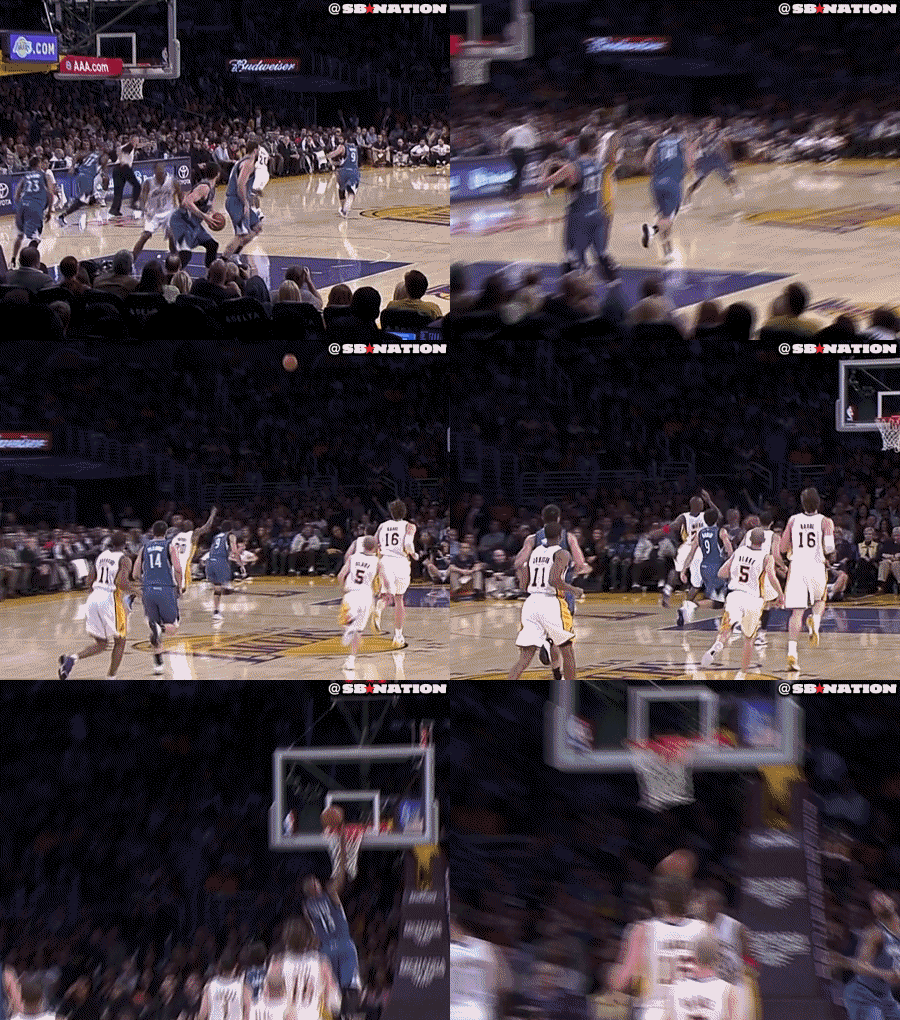
If you're not convinced, you can watch him torch one of the other best defenses in the league (the Spurs) for 42 points, and yes, Duncan was playing (though Splitter was out.) He's a devastating offensive player because of his wide variety of moves, use of space, awareness of where to be, and his range. He's great at stepping back quickly behind the line and draining a shot, putting undue pressure on the defense because they're not used to a power forward who can hit those shots -- especially not one who can also handle the ball, drive, or pass. He's the modern 25/13 big man everyone has been waiting for, posting up, crashing the boards, or draining shots from 24 feet. To add insult to injury for any defense planning for him, he's one of the best passers in the frontcourt, and one of the best outlet passers since Wes Unseld.

(Sources: here and here.)
There is some merit to the criticisms about his defense, but they're usually overblown. Players lacking athleticism and size face an unfair amount of negative attention for defense, but if they compete and stay with their team's principles they're usually not liabilities unless they're very old. The best example here is Steve Nash, as most people didn't realize Phoenix's real problem on defense was Amare Stoudemire inside. The most reliable defensive stats we have now come from plus/minus data, and referring to the Talkingpractice blog Kevin Love is slightly above a net zero (i.e. league average.) His Synergy stats are nothing troubling either: 0.88 points per play allowed, with 0.74 on isolation plays (ranked 73rd overall) and 0.73 in the post (ranked 42nd.) For reference, league average offenses like the Knicks score 0.93 points per play overall, and the numbers of iso and post players are generally above 0.8. He's also taken 11 charges this season, tied for sixth in the league. Evidence of Love being enough of a liability to wash out his impact on offense is lacking, unless people (unfairly) rely on things like athleticism and skin color.
(Sources: here and here.)
There is some merit to the criticisms about his defense, but they're usually overblown. Players lacking athleticism and size face an unfair amount of negative attention for defense, but if they compete and stay with their team's principles they're usually not liabilities unless they're very old. The best example here is Steve Nash, as most people didn't realize Phoenix's real problem on defense was Amare Stoudemire inside. The most reliable defensive stats we have now come from plus/minus data, and referring to the Talkingpractice blog Kevin Love is slightly above a net zero (i.e. league average.) His Synergy stats are nothing troubling either: 0.88 points per play allowed, with 0.74 on isolation plays (ranked 73rd overall) and 0.73 in the post (ranked 42nd.) For reference, league average offenses like the Knicks score 0.93 points per play overall, and the numbers of iso and post players are generally above 0.8. He's also taken 11 charges this season, tied for sixth in the league. Evidence of Love being enough of a liability to wash out his impact on offense is lacking, unless people (unfairly) rely on things like athleticism and skin color.
Kevin Love is not their problem in the clutch
While people criticize Love for not being able to lead a team to the playoffs, it would surprise most that by some basic measures of team strength Minnesota is actually one of the strongest teams in the league, with a better adjusted point differential than teams like the Miami Heat. Currently, the Wolves are eighth in the league in SRS, basketball-reference's simple rating system, which should translate to a 32-19 record and a 6th weed. Unfortunately, they're 24-27 in reality, ranked 11th in the west. How does a team's point differential not match with their win-loss record? Typically, it's either from a strange number of one-sided blowouts or a team losing/winning most of its close games. Minnesota is 1-12 in games decided by four points or less, while they've blown teams out by 15 or more points twelve times but only lost by 15 or more two times. They've lost so many close games it's unlikely to stem from "luck." Blowouts, however, are still important to judge the strength of a team going forward, including how they do in the playoffs, but their collapses in close games are troubling.
(Note: people will usually cite the 4 points or less statistic because the Wolves are 1-1 in games decided by five points, and 1-12 looks worse.)
Kevin Love's TS% in clutch situations, where there are five minutes left in the game and the score is within five points, is only 47.9, but shooting percentages dive in these situations league-wide. It's a few spots below the league average, but for comparison Aldridge shoots 47.6%, Dragic 47.4%, and Joe Johnson, whose all-star berth was buoyed by recent game-saving plays, also shoots 47.4%. So to say that Minnesota is one of the most abnormally bad teams in the clutch because of Kevin Love is misguided. He increases his usage rate from 27 to 31 (he's not shying away from the spotlight) and his shooting percentages are not far from the league average in close games and from other star players who are known for heroics.
The culprit here is Rubio. He has been an outright disaster. Using stats.NBA.com's tool and only for players with at least 10 of these games with three minutes per game, Rubio is ranked 151st in the league out of 155 by the NBA's all-in-one "PIE" metric. (Their equivalent of PER.) He has an effective field-goal percentage of 16.7 percent in these situations and a 31.9 TS% (the TS% is boosted by Rubio going to the line for intentional fouls.) Needless to say, 16.7 percent is awful. And their backup point guard, Barea, has been even worse with a 14.3 TS% and fewer assists than Rubio. Kevin Martin and Brewer shoot well in those situations though, but they're feeding off either Rubio or Love. Having a point guard who's a historically bad shooter is enough of a burden for an offense, as defenses can key in on the other players on the court and sag off Rubio, but one who's even worse when the game is close can stall an offense. And their fast break attacks are less common when the game slows down due to all the timeouts. Their offense is a little less effective in the half-court.
The offense, however, with Love shouldering a large burden with the wings Martin and Brewer shooting well, isn't the worst part. Their offensive rating with five minutes to go and within five points is only 99.1, according to stats.NBA.com, compared to their overall average of 104.7, but their defensive rating is 134.9, a ridiculous number, to put it simply. Of course, people love to blame the star for a team's defense, and not anyone else, but there's more at work here. Opponents shoot 45% from behind the arc compared to the season average of 36% -- it's hard to say that's all Kevin's fault here. If you want to blame Kevin's lack of rim protection, opponents are scoring 32 points in the paint per 48 minutes in the clutch; the season average for Minnesota opponents is 45. Ergo, the defense doesn't collapse from his inability to stop players inside. Another factor is that the opposing team is pulling down an obscenely high rate of offensive rebounds: 37.5% of all available boards. But, again, it's not Kevin at fault here: he pulls in an elite 26.6% of defensive rebounds. Pekovic (and Rubio) are the ones whose defensive rebound rates fall by almost half, and Dante Cunningham, who replaces Love when he's out sometimes, rebounds like a point guard when the game is close.
Historically bad shooting from their point guards and bad luck have given Minnesota a terrible record in close games. The prime example was a game against the Mavericks they lost by two points where the last play of the game was a Marion "block" on a Kevin Love jump shot. In fact, the NBA admitted they made a mistake in not calling a foul, which would have sent Love to the line for two free throws to tie the game. Also, many of these close losses come from games where the Wolves have a sizable deficit and claw their way within striking distance but come up short when time expires; it's not that they're choking away games they already game. For example, with three minutes to go against the Kings, they rally to come within just one point, thanks to plays like Love's back-to-back three's. (This partially explains the horrible defensive rating because they have to intentionally foul.)
Minnesota has lost an unusually large amount of close games, but the cause does not appear to be Kevin Love. Opposing teams are hitting their three's and crashing the offensive boards, but Love's the only one rebounding well. We can't expect the Wolves to keep losing all their close games at such an absurd rate; the magic of regression to the mean will lift their record. Even Rubio can't keep shooting that poorly.
Conclusion
If Kareem, undoubtedly a top three player of all-time, can miss the playoffs two seasons in a row in his mid-20's during a time when many of the best players were in another league, and still not lose his spot in the Pantheon, then why can't Kevin Love be a top four player during a single season? Kevin Garnett matched the same feat three straight seasons with the same Minnesota franchise. To simply throw away Love's candidacy for all-NBA for top five MVP consideration because his team missed the playoffs in the toughest western conference ever, arguably, is lunacy. If you think Love can't lift a team with a few decent players, then you're ignoring how Minnesota is 8th in the league in adjusted plus/minus -- he's doing a better job, using one basic but effective team metric, than LeBron James! When Kevin's on the court, his team's offense is devastating. To ask Kevin to do more, that it's his fault, is bewildering because of how much he's already doing. It's not his fault Rubio is a terrible shooter and is even worse when the game is on the line.
We haven't learned from Kevin Garnett's case, which was a fairly recent occurrence. I do not have confidence the media and fans will treat Love appropriately. We place too much credit on the star players for team records, especially in close games. To say that Love is choking is odd because his shooting percentages mirror that of Aldridge's and Joe Johnson's. Maybe one day we'll learn. But with Minnesota's playoff chances dwindling every game, we're going to see more press about how Love isn't a "winner." And it's not fair.
Kevin, it's not your fault.
