Monday, February 10, 2014

Kevin, It's Not Your Fault

History has given us important lessons that we soon forget. With Minnesota in danger of missing the playoffs again while Kevin Love delivers one of the most impressive seasons in recent years by most metrics, we're going to be treated to countless arguments about how he doesn't deserve to be on an all-NBA team or an MVP ballot because "he" failed to lead his team to the promised land. But before we use some archaic, color-by-numbers approach to evaluate a player, we should use some perspective and context -- this is a time when an ocean of statistics are available and every play is available for viewing online. We can do better than "his team didn't make the playoffs."

Looking to history for similar situations

Years ago, one of the most intimidating, giant, and highly skilled players, an MVP and statistical monster, missed the playoffs in two straight seasons during his prime, even while playing heavy minutes. The conventional wisdom has always been that you cannot be a superstar if you fail to lead your team to the extra-season, but he broke those rules and caused people to question either how good he was or how we perceived team success. It was difficult to argue what more he could have done because he filled up the stat-sheet in numerous categories with gargantuan numbers. Was he not a leader? Was he only playing for his own stats? Later, when paired with better players, he coincidentally won a championship and the critiques faded away; he was now a "winner."

Today, that player, Kareem Abdul-Jabbar, is regarded as one of the best players of all-time. The consensus is that he's at least the third best player ever and maybe even higher. Media figures like to use the line "you can't be a star if you can't lead your team to the playoffs," including Bill Simmons, who said back in 2006 said, "Can you name another alleged "superstar in his prime" who missed the playoffs for two straight seasons?" Somehow he missed Kareem, and this is a guy who watched Kareem in person back in the 70's and wrote a book on the history of the league.

And it's not just Kareem. Barkley missed the playoffs in 1988 and won only 36 games, while repeating the feat in 1992 with 35 wins before being traded to a better team the next season, where he immediately went to the finals (that should sound familiar.) Moses Malone, loved by the old-guard and the mainstream media, missed the playoffs in 1978 and won 41 and 40 games, respectively, in 1980 and 1981, though he still managed to pick up three MVPs between 1979 and 1983. He also joined a talented 76ers team with a superstar in Dr. J along with a great supporting cast in Bobby Jones and Mo Cheeks, among others, and they had been going deep in the playoffs every season, including three finals appearances in the six seasons before Moses.

Kobe missed the playoffs in 2005 after Shaq left and nearly missed again in 2006; the 2014 Wolves may actually match their win total but could miss out due to the abnormally strong western conference. Olajuwon had four straight seasons of mediocre 40 to 46 win teams while he was in his 20's, but always gained entry to the playoffs due to the weak conference at the time, except later in 1992 when, in the prime of his career at age 29, they managed a meek 42 wins.

Some of the greatest players of all-time have either missed the playoffs in their prime or failed to clear the 0.500 Mendoza line. If even the best players ever near the top of their games can't push every team they have past 45 wins or worse, then why can't Kevin Love be an elite player when they're on pace for 40 to 42 wins with a point differential that suggests an even stronger team? People will cite how he's never been to the playoffs and will even include his 2013 injury-plagued season, but they fail to study the context, which is especially relevant for one of the most incompetent franchises in the modern era.

But the most similar case, arguably, happened with the same franchise less then ten years ago and they, oddly enough, share the same first name. Kevin Garnett missed three straight playoffs while averaging 22 points, 13 rebounds, 5 assists, 1.5 steals, and 1.4 blocks a game. In fact, Garnett's only one of five players in NBA/ABA history who have led their teams in total points/rebounds/assists/blocks/steals, and he narrowly missed the feat (by only six blocks) in 2005. He also missed the feat in 2006 by a measly four steals. He missed the playoffs, but what more could he have done as the leading scorer, passer, rebounder, and defender?

If you thought Garnett was just a "good stats on a bad team" player, then the ultimate test would be to put him on a team with good players and a good coach, and, obviously, that's exactly what happened. The result, even though Garnett was a little past his prime? A dominating season with one of the best modern defenses of all-time, and a championship that included several lopsided wins. (People cite their losses, but overall a point differential of 5.2 is very strong even for a title team. Hollinger rated it as the 10th best finals team in league history in 2011.)

We've had a prime example of a power forward named Kevin putting up monster numbers for a non-playoff team where people feared he really wasn't a winner, and it was thoroughly refuted, proving that a more comprehensive and thoughtful analysis is needed than "his team didn't go to the playoffs."

Kevin Love's incredible season

People generally rate players based on their basic box score averages, however flawed that is. He excels here since he does pretty much everything on offense, including things not captured by basic stats, and he remains one of the best rebounders in the league.

25.6 points, 13.3 rebounds, 4.0 assists.

The list of people who have matched those averages is extremely short. Only Wilt Chamberlain, Elgin Baylor, Billy Cunningham, and Kareem Abdul-Jabbar have averaged at least 25 points, 13 rebounds, and 4 assists a game. And those seasons were aided by the high pace of the early NBA, inflating rebound totals and other stats. In fact, looking at per possession stats, no one else matches Love's combination of high volume, high efficiency scoring, elite rebounding, and great passing: a usage of at least 28, a TS% above 58, a rebound rate above 19, and an assist rate above 19 (via basketball-reference.) Relaxing the thresholds to a usage of at least 27 (remember league average is 20, and the league leader is typically a little over 30), a TS% of 56 (above league average comfortably), a rebound rate of 18 (still elite, especially for a high scorer), and an assist rate above 17 (assisting on 17% of his teammate's field goals), there are a handful of seasons that qualify since turnovers were first tracked: Kareem in '78, Barkley in '95 and '96, Shaq in '00 and '01, Duncan in '02, '03 and '07, Garnett in '04, and now Kevin Love in '14. That's a list of some of the greatest, well-rounded big men in league history, and Kevin Love is among them. These "one of X players to average this" lists can be arbitrary, but those are all important stats and the standards were relaxed significantly under what Love is doing now.

People counter that Love's points come from "garbage" plays and he only scores in situations like an offensive rebound put-back. It's frustrating to hear that criticism because this is an era where we have an dizzying array of stats and video available. Then there's something basic like his offensive rebounding numbers this year have been low, under 10%, partly due to all his outside shots. Synergy, for example, tracks play types, and you can quickly check how often he scores off cuts, offensive rebounds, post-up plays, etc.

Love favorably compares to other noted interior scorers. Although Kevin's post-up plays are fairly low relative to some of the other scorers, he's in the range of Blake Griffin and Duncan, and he manufactures more of his points from spotting up. If you're going to argue that this is somehow less valuable than posting-up, ignoring how often Love does produce in those plays, then I'll point to the success of many, many modern teams who don't use their big men in this fashion and take more three-pointers than average. Also, as Zach Lowe has pointed out here (near the bottom at number 8 in the list), his accurate outside shooting perplexes and stresses defenses, making it easier for his teammates to score. And by trading in a few post-up plays for spotting up behind the line, he's also more efficient than otherwise and draws out big men from the paint. As the final nail in the coffin that Kevin Love isn't a "real" scorer and lives off garbage shots, he generates 8.3 free throws per 36 minutes, which has only by done by only five other players this season: Durant, Griffin, Harden, Cousins, and Howard.


Play..types....
Post-up
Isolation
Cuts
Offensive rebounds
Spot-up
Kevin Love
Per game
5.8
1.7
1.7
2.7
3.4
Points per play
0.90
0.80
1.24
1.19
1.13
Blake Griffin
Per game
6.9
1.2
2.0
1.5
2.8
Points per play
0.96
0.91
1.25
1.16
0.88
DeMarcus Cousins
Per game
7.8
1.9
1.7
2.7
2.1
Points per play
0.90
0.77
1.25
1.11
0.88
Tim Duncan
Per game
5.0
0.5
2.2
1.3
1.9
Points per play
0.89
0.62
1.15
1.34
0.85
LaMarcus Aldridge
Per game
9.8
1.1
1.4
1.6
3.4
Points per play
0.88
0.89
1.27
1.29
0.88
Zach Randolph
Per game
11.0
1.0
1.4
2.6
1.0
Points per play
0.88
0.58
1.08
1.08
0.79

If you believe Love's numbers are somehow empty, then we're talking about "impact" and there are a new breed of statistics for this -- plus/minus. If his numbers don't actually help his team win, then we shouldn't see an appreciable difference for when he's out of the game; but this isn't true. When he's on the court, Minnesota scores 111.6 points per 100 possessions, which would equate to one of the best offenses in the league, while off the court the team falls to 98.0 points per 100 possessions, which is worse than any other team in the league. They're also a little better defensively when he's on the court, translating to a 16.6 difference when he's on the court compared to off.

If you think that's because of a bad bench and Love sharing minutes with Pekovic and Rubio, one website, talkingpractice, has three different versions of adjusted plus/minus showing that he's indeed a very valuable player. One method calculates a prior rating from a machine learning statistical plus minus to use in an RAPM model (meaning, it's a mix of traditional stats and plus/minus), and Love is ranked third in the league just behind Durant and Curry. But if you want a "pure" plus/minus that knows nothing about a player's stats and only how his team performs when he's on the court compared to off, his non-prior informed RAPM is very strong at +3.6, while another method that uses only a previous season's RAPM as a prior has him at +3.9, which is 12th in the league. Simply put, there is no evidence to suggest that Love's stats are empty and that they don't translate to the team level because, even with advanced models using different methods, his team is much better when he's on the court.

Video evidence

With the availability of video of every play this season, it's lazy to call Love a garbage scorer without first checking the evidence. To remove any doubt he does have a post-game, if the stats weren't enough by showing his post-up frequency, the fifth video in this playlist shows Love going up against the best defense in the league and a good defender in David West. He gets the ball from Rubio, backs his way closer to the basket, and makes a hook shot over West in the paint. 


So yes, Love can score in the post even over a tough defense. Going through the video, he uses the hook shot a lot, including a running hook across the paint. Another common weapon is a turnaround jumper that utilizes his nice touch. He can also seal a deep post position, and can either score easily over his shoulder or use pump fake and get to the line. But his real value is the diversity and range of his skillset. Look at this playlist of shots versus the the top five Warriors defense. There's a hook shot from far away. Then he drives hard to the basket finishing over Bogut. The third video is a contested jumper in David Lee's face, and the fourth a turnaround jumper similar to Aldridge's prime move. Then in the fifth video he shows off his running hook across the lane More of his repertoire is shown below in a game versus the Thunder (a top five defense with good big men defenders.)

Faces up against Ibaka, drives to the rim, pump fakes, gets fouled and makes the shot:

Faces up against Ibaka again, one min. to go and down by two, drives, spins and hits hook shot:

Fights for position against the much bigger Steven Adams, ends up one foot from the basket, easy lay-in:

Spin move against Ibaka while down two points with 27 seconds to go:
If you're not convinced, you can watch him torch one of the other best defenses in the league (the Spurs) for 42 points, and yes, Duncan was playing (though Splitter was out.) He's a devastating offensive player because of his wide variety of moves, use of space, awareness of where to be, and his range. He's great at stepping back quickly behind the line and draining a shot, putting undue pressure on the defense because they're not used to a power forward who can hit those shots -- especially not one who can also handle the ball, drive, or pass. He's the modern 25/13 big man everyone has been waiting for, posting up, crashing the boards, or draining shots from 24 feet. To add insult to injury for any defense planning for him, he's one of the best passers in the frontcourt, and one of the best outlet passers since Wes Unseld.
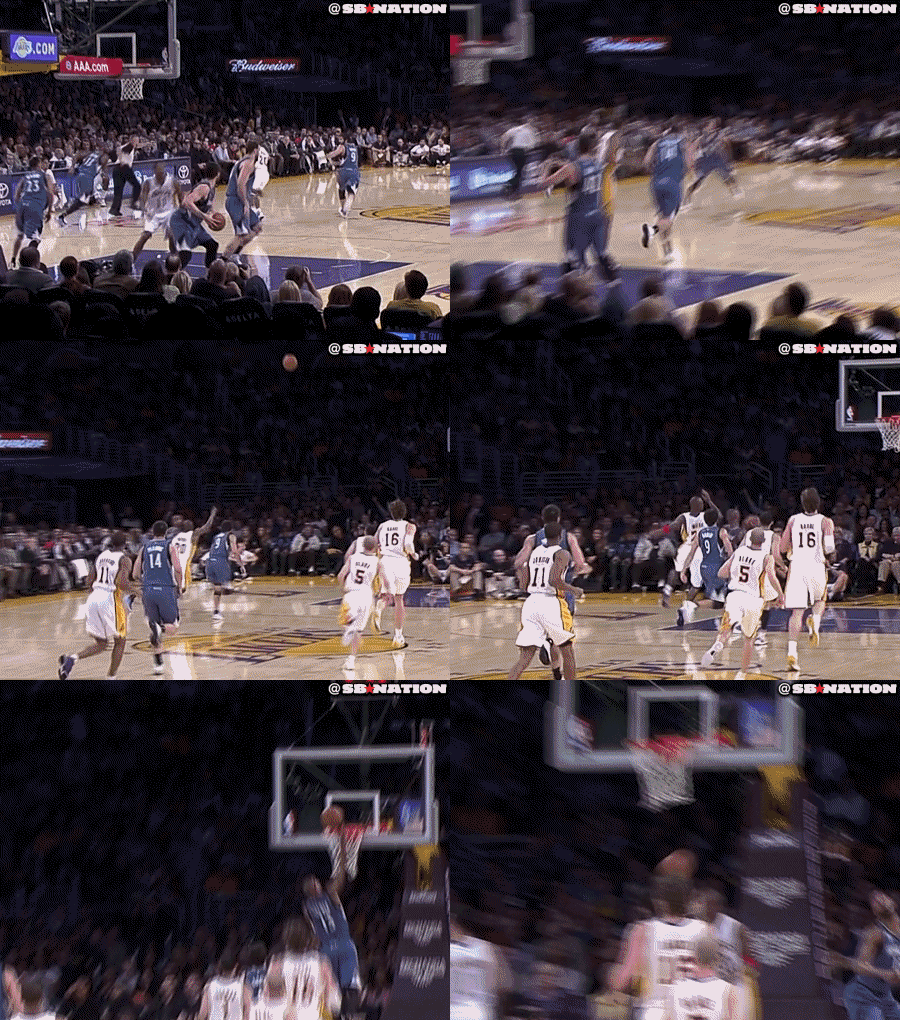


(Sources: here and here.)

There is some merit to the criticisms about his defense, but they're usually overblown. Players lacking athleticism and size face an unfair amount of negative attention for defense, but if they compete and stay with their team's principles they're usually not liabilities unless they're very old. The best example here is Steve Nash, as most people didn't realize Phoenix's real problem on defense was Amare Stoudemire inside. The most reliable defensive stats we have now come from plus/minus data, and referring to the Talkingpractice blog Kevin Love is slightly above a net zero (i.e. league average.) His Synergy stats are nothing troubling either: 0.88 points per play allowed, with 0.74 on isolation plays (ranked 73rd overall) and 0.73 in the post (ranked 42nd.) For reference, league average offenses like the Knicks score 0.93 points per play overall, and the numbers of iso and post players are generally above 0.8. He's also taken 11 charges this season, tied for sixth in the league. Evidence of Love being enough of a liability to wash out his impact on offense is lacking, unless people (unfairly) rely on things like athleticism and skin color.

Kevin Love is not their problem in the clutch

While people criticize Love for not being able to lead a team to the playoffs, it would surprise most that by some basic measures of team strength Minnesota is actually one of the strongest teams in the league, with a better adjusted point differential than teams like the Miami Heat. Currently, the Wolves are eighth in the league in SRS, basketball-reference's simple rating system, which should translate to a 32-19 record and a 6th weed. Unfortunately, they're 24-27 in reality, ranked 11th in the west. How does a team's point differential not match with their win-loss record? Typically, it's either from a strange number of one-sided blowouts or a team losing/winning most of its close games. Minnesota is 1-12 in games decided by four points or less, while they've blown teams out by 15 or more points twelve times but only lost by 15 or more two times. They've lost so many close games it's unlikely to stem from "luck." Blowouts, however, are still important to judge the strength of a team going forward, including how they do in the playoffs, but their collapses in close games are troubling.

(Note: people will usually cite the 4 points or less statistic because the Wolves are 1-1 in games decided by five points, and 1-12 looks worse.)

Kevin Love's TS% in clutch situations, where there are five minutes left in the game and the score is within five points, is only 47.9, but shooting percentages dive in these situations league-wide. It's a few spots below the league average, but for comparison Aldridge shoots 47.6%, Dragic 47.4%, and Joe Johnson, whose all-star berth was buoyed by recent game-saving plays, also shoots 47.4%. So to say that Minnesota is one of the most abnormally bad teams in the clutch because of Kevin Love is misguided. He increases his usage rate from 27 to 31 (he's not shying away from the spotlight) and his shooting percentages are not far from the league average in close games and from other star players who are known for heroics.

The culprit here is Rubio. He has been an outright disaster. Using stats.NBA.com's tool and only for players with at least 10 of these games with three minutes per game, Rubio is ranked 151st in the league out of 155 by the NBA's all-in-one "PIE" metric. (Their equivalent of PER.) He has an effective field-goal percentage of 16.7 percent in these situations and a 31.9 TS% (the TS% is boosted by Rubio going to the line for intentional fouls.) Needless to say, 16.7 percent is awful. And their backup point guard, Barea, has been even worse with a 14.3 TS% and fewer assists than Rubio. Kevin Martin and Brewer shoot well in those situations though, but they're feeding off either Rubio or Love. Having a point guard who's a historically bad shooter is enough of a burden for an offense, as defenses can key in on the other players on the court and sag off Rubio, but one who's even worse when the game is close can stall an offense. And their fast break attacks are less common when the game slows down due to all the timeouts. Their offense is a little less effective in the half-court.

The offense, however, with Love shouldering a large burden with the wings Martin and Brewer shooting well, isn't the worst part. Their offensive rating with five minutes to go and within five points is only 99.1, according to stats.NBA.com, compared to their overall average of 104.7, but their defensive rating is 134.9, a ridiculous number, to put it simply. Of course, people love to blame the star for a team's defense, and not anyone else, but there's more at work here. Opponents shoot 45% from behind the arc compared to the season average of 36% -- it's hard to say that's all Kevin's fault here. If you want to blame Kevin's lack of rim protection, opponents are scoring 32 points in the paint per 48 minutes in the clutch; the season average for Minnesota opponents is 45. Ergo, the defense doesn't collapse from his inability to stop players inside. Another factor is that the opposing team is pulling down an obscenely high rate of offensive rebounds: 37.5% of all available boards. But, again, it's not Kevin at fault here: he pulls in an elite 26.6% of defensive rebounds. Pekovic (and Rubio) are the ones whose defensive rebound rates fall by almost half, and Dante Cunningham, who replaces Love when he's out sometimes, rebounds like a point guard when the game is close.

Historically bad shooting from their point guards and bad luck have given Minnesota a terrible record in close games. The prime example was a game against the Mavericks they lost by two points where the last play of the game was a Marion "block" on a Kevin Love jump shot. In fact, the NBA admitted they made a mistake in not calling a foul, which would have sent Love to the line for two free throws to tie the game. Also, many of these close losses come from games where the Wolves have a sizable deficit and claw their way within striking distance but come up short when time expires; it's not that they're choking away games they already game. For example, with three minutes to go against the Kings, they rally to come within just one point, thanks to plays like Love's back-to-back three's. (This partially explains the horrible defensive rating because they have to intentionally foul.)

Minnesota has lost an unusually large amount of close games, but the cause does not appear to be Kevin Love. Opposing teams are hitting their three's and crashing the offensive boards, but Love's the only one rebounding well. We can't expect the Wolves to keep losing all their close games at such an absurd rate; the magic of regression to the mean will lift their record. Even Rubio can't keep shooting that poorly.

Conclusion

If Kareem, undoubtedly a top three player of all-time, can miss the playoffs two seasons in a row in his mid-20's during a time when many of the best players were in another league, and still not lose his spot in the Pantheon, then why can't Kevin Love be a top four player during a single season? Kevin Garnett matched the same feat three straight seasons with the same Minnesota franchise. To simply throw away Love's candidacy for all-NBA for top five MVP consideration because his team missed the playoffs in the toughest western conference ever, arguably, is lunacy. If you think Love can't lift a team with a few decent players, then you're ignoring how Minnesota is 8th in the league in adjusted plus/minus -- he's doing a better job, using one basic but effective team metric, than LeBron James! When Kevin's on the court, his team's offense is devastating. To ask Kevin to do more, that it's his fault, is bewildering because of how much he's already doing. It's not his fault Rubio is a terrible shooter and is even worse when the game is on the line.

We haven't learned from Kevin Garnett's case, which was a fairly recent occurrence. I do not have confidence the media and fans will treat Love appropriately. We place too much credit on the star players for team records, especially in close games. To say that Love is choking is odd because his shooting percentages mirror that of Aldridge's and Joe Johnson's. Maybe one day we'll learn. But with Minnesota's playoff chances dwindling every game, we're going to see more press about how Love isn't a "winner." And it's not fair.

Kevin, it's not your fault.

Monday, February 3, 2014

Evaluating Hack-a-Shaq

Years ago, a giant center used to destroy teams on his own, putting up monster statistics with high accuracy from the field. He was an unmovable object with superhuman strength, and he seemed like the ultimate offensive weapon. He did have one weakness, however, his kryptonite -- free-throw shooting. With several seasons below 50% from the line, teams would intentionally foul him because it was much better than the alternative. People argued that he was so poor from the line, in fact, that he was detrimental to the team whenever the strategy was employed.

At the time, the strategy wasn't called Hack-a-Shaq because it was used against Wilt Chamberlain. The league changed some rules regarding fouls called in the last two minutes and the strategy laid dormant for decades until eccentric basketball mind Don Nelson used it against Dennis Rodman and then Shaquille O'Neal. Unfortunately, it's still an active weapon, most notably against Dwight Howard. There are ongoing debates about the merits of keeping this a part of basketball -- it's ugly and slows down the game versus if a player doesn't want this used against him, he should work on his shooting -- but what's missed most often is how effective it is as a strategy. People discuss how sending a 55% foul-shooter to the line results in a "worse" offense, but don't compare it to how efficient the team normally is and ignore the possibility of offensive rebounds.

Breaking down Hack-a-Shaq, there are four components for evaluating its potency:
1) The foul-shooter's percentage from the line
2) The chance of an offensive rebound off a miss
3) The offensive rating after the offensive rebound
4) The offensive rating of the team if you don't intentionally foul

Combining 1) through 3), you can compare the offensive rating of the intentional foul to 4). If the resultant offensive rating for a Hack-a-Shaq isn't lower than the team's offensive rating without fouling them, then it's probably not a worthwhile strategy, unless you have other motivations like stopping the clock.

The formula for a Hack-a-Shaq offensive rating is pretty simple:
100*(2*FT%/100+(100-FT%)/100*FTORB*FTORTG/100)

where
FT%: a player's free throws percentage (in the form of 60% and not 0.60)
FTORB: the team's chance of grabbing an offensive rebound after a free throw miss (in the form of 0.20, not 20%)
FTORTG: the team's offensive rating after a FTORB (per 100 possessions, i.e. 110 points)

The 100 at the beginning is to translate the number into points per 100 possessions. The first part of the equation inside the parenthesis are the expected points you get sending the player to the line, and the second part is the expected points from an offensive rebound given the chance of an available rebound (a miss) and the chance of the offensive team grabbing it. So with the formula explained, here's a simplified version (with the extra 100's):

Hack-a-Shaq ORTG = 2*FT%+(100-FT%)/100*FTORB*FTORTG

The FT% is the easier variable to find. You can simply use the player's season average, the average from his last three seasons, or his career average.

The variable FTORB, however, is trickier to find. It's not an official stat tracked by any site (least not that I could find) and it can't be deducted from conventional stats. There have been a handful of studies of offensive rebounding based on the shot type, like this early one from 82games.com or a recent one from hoopdon. The former study found a 13.9% OREB after free throw misses, while the latter using NBAWOWY's site found an average of 12%. The past couple seasons have seen an average of all offensive rebounding around roughly 26%, so there's clearly a substantial drop when rebounding after a missed free throw. (82game's higher figure, by the way, stems from the slightly higher offensive rebounding numbers in the mid-00's and because it included team rebounds.)

But the analysis doesn't end here. When, say, Dwight Howard is at the line, we cannot assume a 12% average because of two complicating factors: one being that Howard, the team's best offensive rebounder, is now far from the rim, and secondly when he's at the line players expect a missed free throw and fight harder for an offensive rebound. Reading play-by-play data, it's possible to calculate offensive rebounding values for when the infamous free throw chuckers miss. What's surprising is that despite having Houston's team offensive rebounder at the line and playing a significant portion with smallball lineups, the Rockets have rebounded at an above average rate when he misses a free throw.

Player.............
OREB% FT miss
FT%
FT misses
Dwight Howard
0.171
53.3
129
Andre Drummond
0.091
40.7
55
DeAndre Jordan
0.172
41.3
64

With some approximations of rebounding percentages, the next step is the expected points after the rebound off the free throw miss. This issue has been studied before, and one can expect a significantly higher effective field-goal percentage off a miss than most other actions (like a made field goal on the other end.) For instance, the Rockets have an eFG% of 56.4 after a free throw offensive rebound compared to their season average of 51.9%, while the Clippers have averages of 56.8% and 52.8%, respectively. Until I get more data specifically for offensive rating after misses, I'm going to assume a conservative increase in efficiency after these misses -- 5 points per 100 possessions, compared to nearly 10 points that I've found from NBAWOWY, depending on the team/personnel.

With these numbers, one can now calculate Hack-a-Shaq offensive ratings. For example, using the averages for Howard and his team this season:

Hack-a-Shaq ORTG = 2*FT%+(100-FT%)/100*FTORB*FTORTG

Hack-a-Shaq ORTG = 2*53.3+(100-53.3)/100*0.171*(109.3+5)

Hack-a-Shaq ORTG = 115.7

Compared to Houston's rating of 109.3 for this season, it is not wise to put him on the line intentionally because you are effectively giving them a very high offensive efficiency (like the Nash-Suns at their very best) and one that's much higher than what you'd expect without fouling him. I'm sure people also want a Shaq-specific example, so during the 2001 regular season in LA he shot 51.3% (his worst season during the title stretch) with an offensive rating of 108.4. Using estimates of a 15% FTORB and a conservative FTORTG 5 points above their regular season average, this translates to a Hack-a-Shaq ORTG of 110.9 points per 100 possesions -- so yes, even during one of his poorest shooting seasons in LA, it was still an unwise strategy.

Or you can solve for what FT% Howard would need for this to be a break-even strategy (meaning, a percentage lower than this means it's an effective strategy.)

Hack-a-Shaq ORTG = 2*FT%+(100-FT%)/100*FTORB*FTORTG

109.3 = 2*FT%+100/100*FTORB*FTORTG-FT%/100*FTORB*FTORTG

109.3 - 100/100*FTORB*FTORTG = 2*FT%-FT%/100*FTORB*FTORTG

109.3 - FTORB*FTORTG = FT%*(2-1/100*FTORB*FTORTG)

FT% = (109.3 - FTORB*FTORTG) / (2-1/100*FTORB*FTORTG)

FT% = 49.7

(Even with an OREB% of 10, the break-even point is still only around 51.9%.)

Fifty-percent is a reasonably good break-even line for big men on good teams in most scenarios. Note that there's a high degree of elasticity with regards to free-throw percentage (i.e. FT% greatly changes the Hack-a-Shaq efficiency.) Free-throw OREB% has a lower elasticity, while ORTG after a missed free-throw is greatly inelastic. To visualize this, I prepared a series of charts showing how Hack-a-Shaq efficiency changes with each respective variable. Since there are three independent variables and one dependent variable (the result), it's a bit like four-dimensional graphing, so there's a chart for five different OREB rates, where the x-axis is FT% and the y-axis for the Hack-a-Shaq efficiency, and then one line each for a team's ORTG after a missed free throw.


What's surprising is that Dwight Howard gets all the attention for that Hack-a-Shaq strategy when he's comfortably past the break-even line, but both Drummond and DeAndre are two of the worst foul shooters ever and are far below the efficiency threshold. Even if their team rebounds their misses at a high rate, the result is an offense that would perform worse than the 2012 Bobcats, who won only 7 games. The Clippers' offense is a high-powered one featuring the best point guard in the guard, one of the best scoring big men, and several outside shooters, but you can stall their offense by sending DeAndre Jordan to the line. He's only had one season above 50% and needs to improve so he's not a liability whenever the team is in the penalty.

The strategy is ugly and an effrontery to the beauty of the game, but it's also less effective in most situations than most people realize. With the relevant data, it's also fairly simple to calculate. (This will probably spawn another study looking at how a free throw miss offensive rebound percentage changes based on who's at the line.) For most of Shaq's career it was an inappropriate strategy because it gave his team a higher offensive rating than they had otherwise, and this is true of Howard too as his two worst seasons had free-throw percentages of 49, which is straddling the break-even line. When both guys were near 60%, it was an especially stupid strategy.

But you can still have fun with it.

Wednesday, January 29, 2014

The 2014 Eastern Conference All-star Game Picks

One idea floating around about the all-star game that has picked up steam is to do away with teams by conferences, pick the 24 "best" players, and let two captains pick sides. During a historically bad year for the east, this has gained traction, and I'd be fine with it since it's always a glorified pick-up game. I say this because I had to seriously consider the candidacy of guys like Afflalo and Lance Stephenson. Meanwhile, guards like Tony Parker and Mike Conley could miss the all-star game. Nevertheless, I had to attempt to scrabble together a competition eastern conference team.

Speaking of Lance Stephenson, a campaign has spread for his inclusion in the all-star game, and I'm not sure what people think they're accomplishing. First of all, insisting that Indiana should have three all-stars is weird and misguided; an elite team will be awarded by winning (by itself it's a reward) and by playoff success. And Indiana's strength is its well-balanced starting five, not having three stars. In fact, you can have a 60+ win team with only one all-star or, theoretically, zero. Think about this: a great team will have a point differential of, say, +7. The top players in the league will be around +4 to +6 overall just by themselves (but not this is if they played an entire game of 100 possessions.) A player that's a +2 is likely a good role player or a fringe all-star.

So let's say our fictional team has one great star who's +6, and he's surrounded by four solid starters who average +1.5. That's 6+4*1.5, equaling +12 overall, if the starters played the entire game. Bench players, especially the guys who ride the end of the pine, are typically "negatives," but if the bench is decent enough, like Indiana's this year, that +12 overall won't be depressed by a huge amount. Last season, Indiana's starters played 64% of their total regular season minutes, so let's pretend this team gets 60% of their minutes from their starters and 40% from a bench that averages a -1 impact (a poor player, but nothing horrific.) That means you have a weighted average for a point differential of +6.8, which would make them one of the best teams in the league. But we gave them only one star. It's evident that there's no perfect relationship between team strength and number of all-stars. As John Hollinger said, the all-star game is not about parliamentary representation; just pick the best players!

(By the way, that works even with other metrics like basketball-reference's Win Shares. The best non all-stars average like 5 to 8 Win Shares a season, and even Indiana's bad bench last season had 14.2 Win Shares. That means you could build a non all-star team with a poor bench that could win, say, 50 games, and if you add one superstar you can close in on 60 games, which is a reasonable facsimile of the LeBron-era Cavaliers.)

And realize we're constructing this edifice for a guard with a usage rate under 20 for an offense on a slightly below average offense. Lance is lauded for his "playmaking," but the results haven't been extraordinary, he turns the ball over too much, and he definitely has useful offensive players around him. Also, note that usage rate includes turnovers, so Lance is an even smaller part of the offense than it looks. As Kevin Pelton noted, the only two guards who made the all-star team with a usage rate below 20 and less than 7 assists a game since the turn of the millennium have been legendary shooter Ray Allen and Andre Iguodala, who's both a better playmaker and defender than Stephenson. If you go back to the 90's you'll see a couple more super-role players like Dumars, but you'll also see some of the worst all-star selections ever like BJ Armstrong. Basically, unless you're a top-tier distributor, defender, or shooter (Majerle and Ainge made the cut), you're unlikely to make the team. (If you go back further you'll find more guards, but as the league got smaller it meant there were more all-star spots for each player.)

If people want Lance to make the team because of his defense, I'm not seeing it anywhere, at least without a great deal of certainty. Indiana's defense is scary, but Hibbert and George are the best defensive players. Stephenson has cut down his mistakes, but I don't think he's good enough as a perimeter defender that he's a lock. Yes, the east is historically weak, but what are we doing with this campaign? All we're essentially doing is making Stephenson more expensive for his team to sign him after his rookie contract expires, and in their small market it might make keeping him impossible. So this strange obsession people have with proclaiming him an all-star will just have the effect of dismantling the dominating starting lineup of one of only two great teams in the eastern conference and the only bump on the road to the finals the Heat will face.

And, finally, here are my picks for the all-star team....

Starters:

Guard: John Wall

There are a few impassioned debates about who's the best point guard in the east right now, driven by the fanbases of Cleveland and Washington. Wall's case is more traditional than one would expect, given his errant jump shot and his flashy dunks -- he controls Washington's offense with his passing, and their offense falls apart without him. He's fourth right now in assists per game, or fifth if you include Kendall Marshall (i.e. the D'Antoni surprising, resurgent point guard du jour.) He's also fourth in "hockey assists" per game and moves up to third in the league in assist opportunities per game, per SportVu, basically implying that Wall's teammates are deflating his assist totals. Washington, meanwhile, has an offensive rating of 106.9 when Wall is on the court, and that plummets to an unfathomable 93.8 without him. This is the intersection of two strains of data types in this information world, and without juxtaposition they could be meaningless. But together it shows the large amount of control Wall wields -- he's, in fact, leading the league in time of possession per game, again from SportVU. However, since he plays heavy minutes and hasn't missed a game, his raw on/off differences are likely to be dramatic because a large portion of those off minutes consist of garbage minutes without any starters or only one. More nuanced metrics, controlling for teammates and the strength of the opponent, are more modest with their appraisal of Wall, but this is a historically dreadful east and there are few guards even approaching "star" status. For the last stat explaining how Wall sets up his teammates, Bradley Beal's TS% without John on the court is, via NBAWOWY, 43.6.

Guard: Dwyane Wade

I'm not entirely comfortable putting Wade in the starting lineup since he's missed a large number of games, but based on pure quality he's still the best shooting guard in the east (dubious award though) and, hey, Wall-Wade-George-LeBron looks like a really fun quintet. The rumors of Wade's decline have been exaggerated. Wade's motto is: always play hard. This will impress some people, and astonish the rest. But after years of falling down hard (or embellishing contact), and after years of injuries, he's no longer a sure thing on the court. Yet he's still generating a lot of shots on very good efficiency while passing well and finding players at the rim. He's a terror in transition, and he gets a pass for some missed games here because he's made three straight finals. They're keeping him fresh for a reason. I could see an argument for Lowry over Wade in the starting lineup, sure, but I prefer not to have two point guards starting, and Wade has the requisite box score stats and the "impact:" an RAPM version, free of box score stats, has Wade in the top 20 at +3.3.

Forward: Paul George

The reigning Most Improved Player, he's once again a viable candidate. In fact, last season was an odd case: he locked up the award playing for a good team and increasing his minutes by nearly 8 per game. His largest improvement came from his perimeter defense, so in a backdoor way he did deserve the award, but the media typically neglects defense unless it's propped up by gaudy block/rebound stats. He's maintained his status as an elite perimeter defender, but he's surged to stardom thanks to a legitimate high-scoring game. His shooting percentages have risen on virtually every area of the court, depending on how you slice it up, even though he's taking more shots, including difficult fadeaway jumpers. There should be absolutely no qualms about George being an elite player now. He's scoring efficiently on a fairly high volume without much help; it's not like he's being set up by one of the best playmakers in the league. And coupled with his defense, and he's a two-way force. Indiana's offense is overrated because their win total hides the fact their offensive efficiency is below average even with outstanding offensive rebounding, but that's through no fault of George and he's a key part in a defense that's putting everyone else to shame. The Bulls' defense is closer to the 9th rated Clippers than the Pacers.

Forward: LeBron James

I don't need to spend much time explaining why LeBron should be in an all-star game, even when he's "LeCoast." For one fun fact, with a usage of 29.9 via b-ref and a TS% of 65.9, he's literally off the charts in terms of usage and efficiency. (And actually, so is Durant.) Even though he's dialing back the effort on defense and his turnovers are up, he's breaking the laws of basketball -- he's second in the entire league in post-up efficiency at 1.17 points per game from Synergy, and it's not on a trivial amount of plays either; he's posted-up 156 times. He's also tailored himself as an excellent spot-up shooter, as SportVU ranks his effective field-goal percentage third out of 195 players with at least 20 games and 2 catch-and-shoot attempts per game. He's shooting 51% on those three-pointers. Once derided for his lack of finesse skills, his versatile skillset is a nightmare in a variety of situations.

Forward: Roy Hibbert

I should take more credit for defending Mount Verticality in the first half of the 2013 season, explaining that his shooting percentages were likely an aberration due to an injury and that his other stats held steady. Then in the playoffs the Indiana defense lurched into high gear against the Miami Heat, taking them to seven games. They have nearly perfected their own brand of defense and are currently 9.5 points better than the league average on defensive efficiency per 100 possessions. For people unfamiliar with these stats, that is unprecedented in modern basketball. The Ewing-Oakley-Riley Knicks peaked at 8.3 in 1993. The Duncan-Popovich Spurs peaked at 8.8 in 2004. The Garnett-Perkins Celtics peaked at 8.6. Outside of Bill Russell's Celtics, this could be the most impressive defensive season we've ever seen, relative to one's peers. The historically weak east takes a little oomph out of their stats, but this is still mighty impressive, especially since this is an age with an unprecedented amount of information and a wave of people trying to emulate the defensive success of guys like Thibodeau and Popovich. His box score stats may seem modest, but it's the tip of the iceberg -- the defensive stats of the Pacers are gargantuan, and Hibbert is their most important defender, guarding the restricted area. His defensive rebounding looks anemic, but Indiana leads the league in DRB% and their perimeter players get in on the action. He's also has a decent utility on offense for a center, more usable than types who can't create their own shots. If you were to take one center for the game, Hibbert is the choice if you want to win.

Reserves:

Guard: Kyle Lowry

The point guard competition in the east is seriously weak, as one could argue probably two players from the west who won't be picked over any point guard here. With Rose injured again, Irving failing to take a leap forward, and even Rondo limited, Lowry has unexpectedly put his hat in the ring. Offensively, he's taken on a healthy share of his team's offense with his shot creation and assists, and his shooting percentages have been excellent. He's taken care of the ball too with a 3.4 assist/turnover ratio. As a result, the Raptors have an offensive rating higher than Indiana, even with Rudy Gay's epic shooting problems -- if Gay had shot at the league average, he would have had 50 more points over only 18 games. In the blight that is the eastern conference, Toronto has been one of the few bright spots and Lowry has played a central role. Not only is he good offensively, but when properly competing he's one of the best defensive guards too. He's averaging 1.6 steals and 1.2 charges taken a game, which is the highest mark since 2007 from Varejao and Andrew Bogut, via Hoopdata. He's a bulldog defensive point guard who's a plus when he's motivated and not excessively gambling. He's definitely the best guard on the Raptors; let's hope everyone won't be distracted by DeRozan averaging 33% more points ... because he's taking 50% more shots. DeRozan is an "empty calories" scorer who offers nothing else of value and doesn't even score proficiently. Somehow Lowry's on the trading block, according to some people, but their reigning GM of the year will be smart enough to keep him.

Guard: Kyrie Irving

Like Wall, even though his team's offense is disappointing, it's better when he's on the court and better is an understatement: they score at a pathetic 96.8 points per 100 possessions without Irving, compared to 103.4 when he's on the court. Having a real NBA small forward helps, as they've been better with Deng on board. However, I'm still not sold on him as a player with his weak defense, and I think his crossovers and his dribbling skills don't lead a team to results that are as good as one would think. Unfortunately, there is no viable candidate to replace him, and I'd rather bet on a player who's probably just had a weak slump at the start of the season to a role player who doesn't belong in the game or a fluke season. For instance, Afflalo has gotten a lot of attention for the all-star game, but I feel like we're going to look back years from now and view him like we do Mo Williams. Last season in a similar role his shooting efficiency was poor with how large a chunk of the offense he shared. His TS% has risen 6.2 points.

Looking at his playing style, Afflalo takes a heavy amount of baseline jumpers, especially turnaround shots, usually contested. He's shooting over 50% in a couple of these midrange zones, and my instinct screams "fluky shooting percentages." He was a pretty decent midrange shooter last season, however, and the other reason his overall numbers are up is that his three-point shooting has bounced back from 30% last year (he's near 40% for his career) to 42%. Given his high minutes, he's averaging nearly 20 points per game, but beyond that he's not contributing at all. His overrated defense is now fairly porous given all the energy he expends on the other end, and he provides nothing else of significant value including playmaking. As for Lance Stephenson, I've said my share, and another serious candidate thrown around is ... DeMar DeRozan, a one-dimensional scorer whose only fame to claim is shooting a lot. Otherwise you have to consider guys like Deron Williams, who makes Kyrie Irving look like an MVP, and Joe Johnson, who's already been awarded far too many all-star games after that pact with Satan. So Kyrie Irving gets the selection here, but if someone wants to perform a Freaky Friday with him and Goran Dragic I wouldn't mind.

Forward: Carmelo Anthony

If there were more competition, I could have a nuanced discussion on Carmelo, how he's used in an offense, how we shouldn't judge him based on the disaster surrounding, his aloof defense, etc. If you're going to keep him out of the game because the Knicks are losing most games and you think he's a chucker, then you have to consider guys like Luol Deng or Joe Johnson. We all know his faults, but that means he's not an MVP candidate. A TS% of 55.3 isn't special, but it's not bad either; it's above average. He does this without turning the ball over, and his rebounding is underrated: a 21 DRB% is good enough for a center (although starting next to Bargnani helps a player's rebounding numbers, Carmelo has always been great.) I don't want him starting because of his poor defense and how he can stall an offense -- he averages 17.4 frontcourt touches for every assist -- but he's a lock here.

Forward: Chris Bosh

Bosh is a somewhat forgotten piece now, more known for his goofy antics and video-bombing, but he's still an excellent player on both ends of the court. He's only playing 31 minutes a game, but it's through no fault of his own: the Heat have gone the distance in the playoffs three years in a row and they're resting key guys to be fresh for another title run. Per 36 minutes, he's average 19.5 points with superb shooting percentages and a tiny turnover rate for a big man, stretching the floor for LeBron and Wade. His rebounding and post defense against behemoths is disappointing, but his DRB% is good for a power forward, his natural position, and he takes a pounding from enforcing Miami's strategy of smallball and space/pace. Miami's defense has slipped, but it's not Bosh's fault: when he's on the court their defensive efficiency is 103.0, which would be sixth in the league (currently 11th overall) even though he often plays in smallball lineups. In fact, Bosh has the largest raw +/- on the team, and adjusted RAPM method (non-prior informed) estimates his impact at +4.2, one of the best in the league. His scoring stats would be more impressive if he had a larger role on offense, which is a luxury some of the other guys in the east have, but his accurate midrange shooting is a boon for Miami's offense and he's one of the best pick and roll defenders in the league.

Forward: Paul Millsap

Millsap would have likely been ignored for the all-star game if Horford didn't get injured while Atlanta kept winning. He's long been one of the league's most underrated players without a single flashy strength or style. However, he did add one asset rendering him unique -- he's a good three-point shooter now, taking 2.6 per game at 37%. He's also been a larger part of the offense than he's ever, and he's performing well, including a surprising amount of assists. So he's an accurate big man who can stretch the floor, hit a jumper anywhere, he's not a ball-stopper, he can pass, he rebounds well, he's a good defender, he picks up a lot of steals -- he's just a well-rounded power forward. And he's not leaning on anyone here either. The attention is now on him without Horford and without a Joe Johnson-type on the perimeter.

And while I'm talking about the candidacy of a frontcourt player, let me slam have an opportunity to slam Al Jefferson -- I've seen him on people's ballots over guys like Chris Bosh or Millsap, and I have no idea why. They're averaging a similar amount of points, but Al needs over three more field goals per game to reach his totals. Jefferson's percentages are significantly below average and he's a black hole on offense. The Jazz were always better off with Millsap over Jefferson. People complain about people who overuse things like TS%, but Millsap gives you more points in less shot attempts -- why is that bad? And he's doing it more in the flow of an offense, even shooting from further away and stretching the floor. I'll commend Al's improved defense and that of Charlotte's, but guys like Bosh are still better defenders. You can see this with the "eye-test," you can see this with stats -- it should be obvious.

Wild cards:

Forward: Joakim Noah

Once again, the Bulls are without Rose, and once again they're near league average with an excellent defense and an awful offense. There was no Plan B with Rose -- he was going to be their only scorer, besides Boozer and ... Mike Dunleavy. The team has no business hovering around .500, but they get there with a stifling defense and more ball movement than one would think for an inept offense. Noah represents their strengths, and years later I hope people realize he's a multiple-time all-star because of his defense, rebounding, and passing. His offense is better than most centers; he's not a negative here. A team can play through him in the high post, he has a usable jump shot, and he's unselfish. But as a highly active center, he's the key pivot point of the second best defense in the league. The game today involves lots of switching and pick and rolls, and that's Noah's defensive strength. He's allowed 0.65 points per play in isolation via Synergy ranking 26th, which has involved a few perimeter players, and only 0.74 points per play as the pick and roll defender, ranking an impressive ninth.

I understand that people will argue defense doesn't matter for the all-star game, but the way people talk about all-star appearances, and what it means to the fans, the history of the game, and the players, I'm going for best player. If he were in the west, I could see arguments for Duncan or Dragic over him -- for one, Chicago's defense is better when Noah doesn't play, but I don't think that's accurate -- but I'm more certain taking Noah here than any of the other candidates, like the injured Chandler or Al Jefferson.

Forward: Andre Drummond

This is basically me saying "screw it" and picking someone I'd want to see because I don't think there's a 12th candidate who's deserving anyway. David West is a valuable piece for Indiana, but his scoring stats have slipped: he's not getting to the rim like he used to; it's not fluky jump shooting percentages. Afflalo certainly has a case, but I'm not sure I trust his offensive game right now, which might be unfair but he's really not overwhelming. Jeff Teague hasn't been shooting well, and besides his passing, well, it's Jeff Teague. I'd really like to sneak Dragic across the Mississippi, but alas, I gotta choose someone else.

Detroit is a mess defensively, yes, but I don't think it's because Drummond is a horrible defensive player. Even Asik-Howard was a bad combination, and those two are better than Monroe and Drummond. Drummond without one of those guys on the court still doesn't fix the defense, as when he's paired with Monroe or without both opponents are scoring at a high 111 points per 100 possessions rate, but it's worth noting the Josh Smith-Drummond pair allows only 104.2, which is decidedly above average. He's still learning the subtleties of NBA-level defenses, but he's destroying people on the boards, even with a crowded frontcourt. A defensive rebound rate of 27.8 is truly elite, and an offensive rebound rate of 16.5 is Rodman-esque. And you want him off the boards, because he's one of the best at put-back dunks. They don't run plays for him, ever really, because he's still raw and unskilled, but he still manages to score 14 points per 36 minutes on high efficiency. He's not the most deserving pick, but at least he's super young and could turn into a legitimate star, meaning the pick won't look so strange years from now. Let's enjoy this explosive big man while he can still get up.

The Darkhorse All-star Team

As a bonus, here are my crazy, darkhose all-star picks, filled with players who do not conventionally fit the definition of an all-star, but deserve credit for either being high-performing role players or fringe all-star candidates.

Guard: Isaiah Thomas

Before Cousins had a few monstrous games, I would have easily called him Sacramento's best player, and I honestly still think it's closer than people think. Per possession, his stats are on par with all the best point guards in the league, with the exception of Chris Paul.

Guard: Manu Ginobili

When people talk about the weaknesses of advanced +/-, it's because the results often bounce up and down from year to year, and that specific lineup rotation issues, and who's playing with whom, can drive the numbers. However, Manu is 36 years-old and is once again near the top of the league in advanced +/-, and, excluding Duncan and Parker, who don't even start alongside him, it's with an entirely different cast of characters than the players in the mid-00's. Plus/minus is just about outscoring your opponent -- it's all that matters, in the end. And Manu is the master at pushing the score in his team's direction.

Forward: Andre Iguodala

Iguodala was an actual all-star, but like Manu he's missed a few games due to injury and has a smaller role this season (his usage dropped by almost 5 points.) But he's the glue to Golden State's roster right now, keeping a top-notch defensive unit together, distributing well for a team without a real back-up point guard, and he's even hitting his outside shots, doing a laundry list of important tough tasks for a good team. The Pippen comparisons are apt.

Forward: Amir Johnson

With Rudy Gay and Bargnani gone, Toronto was supposed to be bereft of talent, but they actually improved and immediately after Gay's trade Amir had some monster games. Few people know his game, but he's an active defender who rebounds and blocks shots well, while on offense he actually spaces the floor to nearly the three-point line (he's actually been taking one per game this season) -- yet even with all those long two-pointers he's still a very efficient scorer, much like Bosh. The Raptors have been much better when he plays for a long time, and he deserves some credit.

Forward: Anderson Varejao

Like Noah, he's a highly active center on defense who works well as a high-post facilitator, but health problems have limited his career. He's being wasted on a terrible Cleveland squad, but if he's ever traded to a contender more people would understand his value. As a bonus, he sorta looks like Sideshow Bob.

Reserves

Guard: Wesley Matthews

He's the quintessential 3-D player. Shooting a high percentage behind the arc, even if you close him out he can drive to the basket with reckless abandon. He's also a good, feisty defender, and a key part of a surprising Portland team.

Guard: Lance Stephenson

He's rightfully in the right place here, in the land of role players and sub-stars. In the Pacers disciplined system, he's a tenacious defender and a dynamic offensive guard, rather than a player prone to weird, aggressive mistakes; he's the Stephen Jackson, circa 2003 Spurs, to Indiana.

Forward: Taj Gibson

As one of the game's best defensive players, he'll never receive much attention, especially when coming off the bench, but the value is there. Last year, for example, he allowed only 0.76 points per play on defense, from Synergy. He's strong, quick, blocks shots, rebounds, is fundamentally sound, and has learned from coach Thibs.

Forward: Nick Collison

Battier had a feature about being the "no-stars" all-star, but Collison has held that title for a long time now. Replacing Perkins in the rotation will do wonder for your +/- stats, but he's the role player every elite team would want: he sets great screens, he passes well, he defends at a high level on both pick and rolls and versus post players like Randolph, and he doesn't demand a large part of the offense.

Forward: Andrew Bogut

A former number one pick, Bogut, after years of injury, has turned into an underrated player. At the most important defensive position, he's one of the best in the game, and he's a useful complementary offensive piece due to his passing, finishing ability, and hard screens. Per minute, one could make the argument he's as valuable as all-star centers like Howard and Hibbert. Let's hope he stays healthy (unless he plays against my Blazers in the playoffs, however.)

Reserves:

Guard: JJ Redick

He'd probably make the all-star team in the east, but he certainly doesn't seem like one. However, his valuable shooting and playmaking has helped a Chris Paul-less offense stand the rigors of competition. He's second in the league in distance traveled per 48 minutes, among qualifying players. He plays like a disciple of Reggie Miller and Ray Allen, running around screen after screen for an open shoot, knocking them down with a high degree of precision, and putting an extra gear in an already great offense. I have an appreciation of this type of player and a theory that this is perhaps the best valuable type of offensive support for an elite team relative to its role on the team (i.e. adjusting for volume.) Redick's the piece that makes this Chris Paul team scary.

Forward: Kevin Garnett

Yes, I did say this was a crazy team. He doesn't play enough minutes anymore to deserve an all-star spot, but once again he's quarter-backing the defense and helping the crew in Brooklyn rise to 0.500 basketball while trying to put out wildfires everywhere. Lopez is gone, Deron has been hurt, and the coaching has been ... troubling, but they play better with Garnett. As I said, this is my crazy all-star team.

Tuesday, January 28, 2014

The 2014 Western Conference All-star Game Picks

The ballots are in, and the game will commence with two center-less lineups as Kevin Love edged out Dwight Howard and the east's premier center, Hibbert, doesn't have the flash of Carmelo Anthony. Positions have been an issue with previous all-star games. For years, there was much media attention about the death of the NBA center because the reserve center (and sometimes even the starting center) was usually an awful choice. Duncan insisting he was a power forward exacerbated this issue, and players such as Ilgauskas and Jamaal Magloire were invited to the game.

The NBA's solution, much like their attempt to "fix" the lottery, was an overreaction and just creates a new problem. The real problem with the strict positions of the previous ballot was that many players waffled between PF and C, as the distinction between the two positions had been all but erased on many teams, but for the all-star ballot Duncan was either a PF or a C; there was no in between. The guard-forward-center structure is an archaic one from decades ago, and one possible solution would be to change it the modern standard of point guard-wing-big man. There are still issues with combo guards and picking a point guard in a weak year, but at least it's better to have a subpar year from Kidd in the game than someone like Magloire because at least a point guard can make passes and flashy plays. Instead the NBA oddly decided to group centers in with forwards, and as a result we have two strange looking starting lineups without centers.

While there's nothing abjectly horrifying about this, because at least the most popular players are picked and that's the goal of the NBA ballot, the all-star games represent time capsules to explain the history of the league and it's important they're representative of the current league. Some people like to judge eras by looking at the all-star team to see who was playing, and a George-LeBron-Carmelo frontcourt will look bewildering. To put it simply, I would prefer an NBA starting lineup that makes "basketball-sense." You don't want the first reaction to be, "Huh? LeBron's the center?"

The Correction

You vote for one of each: PG-SG-SF-PF-C

The tweak? A player can be voted for multiple positions based on how he's actually used in a basketball game. LeBron James, for example, would be eligible for SF or PF, Roy Hibbert just C, and Stephen Curry PG and SG. This would eliminate some of the weakest choices in all-star history, as well as any strange lineups where LeBron is the "center."

Western conference picks

Starters:

Guard: Chris Paul*

Even though he's currently injured, I think that he's the best point guard in the league and the third best player in the game (when healthy.) There will be some noise made about how the Clippers have been playing without him, but it's been against a weak schedule and they just got JJ Redick back. (And Paul does have a +5.1 raw plus/minus so far.)  But Paul's same critics ignore the evidence of his value from previous seasons when he was lost for stretches and his team was significantly worse, including when he switched teams and revived a franchise that was considered a laughingstock. He should receive more credit for this.

Chris Paul is still the best point guard in the game, a master tactician and perfectionist who controls the game -- SportVU credits him with 25.3 points created from his assists, far and away the best in the league, along with his 19.6 points per game on high efficiency (which makes him responsible for roughly 60% of the points created whenever he's in the game.) That he can do this while only averaging 2.5 turnovers per game is remarkable, and it makes him a one-man offense. If he's healthy, he deserves to start.

Guard: Stephen Curry

After arguably the best three-point shooting season ever and a surprising run in the playoffs, he's adorned as an NBA star and probably the least-hated top player in the league. The gap between Carmelo and Curry's shooting efficiency last season was smaller than people would think, due to Curry's mediocre scoring inside, and he causes too many turnovers, but he still creates a lot of scoring opportunities for his teammates due to his ability to shoot off the dribble long distance and even elite defenses don't know how to stop him. He's taken a higher load on offense this season while maintaining his efficiency; he's clearly taken a step forward, despite his lowest three-point percentage ever. His quick shooting ability makes him dangerous, as SportVU has him only taking 2.6 catch-and-shoot three's a game ... relative to his 8.4 total attempts per game behind the arc.

Forward: Kevin Durant

Durant, after a remarkable season of shooting efficiency that was only eclipsed by a legendary one from LeBron, is currently in the pole position for the MVP race, and it's well-earned. He's north of 30 PER, which is a rare threshold; his Win Shares per 48 minutes from basketball-reference of 0.329 would be the second highest mark ever behind Kareem in '72; and a plus/minus model (seeded with a statistical model for a prior) rates him as the top player in the league. To put it simply, his game is unfair to the rest of the league. Given his height and long arms, he effectively has the size of a center, but he's one of the best shooters in the league and has become adept at putting the ball on the floor and passing. He's an impossible cover, leading the league in points per touch, which is impressive for someone with as many assists and rebounds as him, and also leads the SportVU statistic for pull-up three-point percentage at 47% out of 56 qualifying players. What are you supposed to do with a player who's at least 6' 10" in shoes who can hit those shots? If you crowd him, he'll go to the rim where he hits his shots at 72% within five feet and nearly 90% from the line. He's a historic force, and he'll go down as one of the best players of all-time.

Forward: Kevin Love

Due to Minnesota's position out of the playoffs currently and their problems in close games, Kevin Love's credentials are being criticized. He's not a "true star" because he can't carry his teammates to wins; he's putting up empty numbers that don't mean anything; he can never have a central role on a great team; etc. People have labeled him a garbage scorer, somehow, who can't create his own shot ... he's currently fourth in the league in points per game with very good efficiency. How is it possible to score 25 points per game while being a garbage scorer? Via Synergy, 25% of his plays have come from post-ups and a good 0.88 PPP efficiency -- that's a high volume of post-up plays, as last season Duncan was at 28%, Brook Lopez 29%, Dirk 26%, and Cousins at 25%. He's the highest non-point guard in touches per game, via SportVu, and even when ignoring defensive rebounds (frontcourt touches only) he's still ranked high among non-guards, ahead of guys like Aldridge, Wade, and Dirk.

People complaining about the lack of elite post scorers in the modern league can look no further -- here's a guy who clears the 20/10 marks by a mile, posts up pretty frequently, can pass well, hits his free throws, sets up his other teammates, shoots behind the three-point line well, drawing out big men and creating attention. He's not conducive to winning, yet when he's on the court, according to 82games.com, his team has a point differential of 9.8 and when he's off it's at a pathetic -10.0? Raw plus/minus has its problems, but even after using advanced adjustments he's still near the top. We've been through this song and dance before with another Kevin. In his prime, Garnett missed the playoffs two straight seasons, and people questioned his superstar status. The next season, he was given great teammates, Pierce and Ray Allen, and immediately won a title with one of the most dominant seasons from a team since Jordan retired. We have failed again to learn from history.

Forward: Dwight Howard

There are some interesting arguments for another forward over Howard, but I prefer a more complete lineup with players in their ideal positions. Paul/Curry/Durant/Love/Howard is a lineup I believe will hold up historically and looks more like a Dream Team. Howard's not a popular player anymore, due to personal problems and a disaster in Los Angeles, but he's still an incredibly effective defender and a better offensive player than people care to admit. He cleans up the boards, remains one of the best rim protectors in the game, has regained his quickness on the perimeter, and posting him up is not a good idea -- I've seen players like Pekovic get destroyed by Howard. People obsess over raw point totals, but I'm more interested in how he passes out of the post and sets screens. And his post game is much better than his detractors indicate, as he's learned counter-moves and is nimble when facing up and driving to the basket. With Marc Gasol sidelined for weeks with a knee injury, I believe Howard was the undisputed best center in the west, since Cousins has problems defensively and Duncan can't play the minutes Howard can. Without Howard, Houston's defense falls off a cliff -- and given his high percentage scoring and work on the boards, and he's an easy all-star.

Reserves:

Guard: James Harden

I have some reservations about Harden, though not as severe as many critics, but he does well with box score metrics and impact stats, from RAPM to the fact that he's the lead scorer/creator for one of the best offenses in the league. His concentration on the NBA's hotspots -- the three-point line and the rim -- may seem like a cheap way to score, but it's effective and style points are not given. His defense is awful, one of the worst for full-time starters, but as a guard it's not enough to offset his scoring. He also has the ignominy of covering the third fewest miles per 48 minutes in the NBA and last among guards, via SportVu and for players with at least 20 games and 20 minutes per game. This is a little surprising given Houston's fast pace, but when he gets the ball he's going in a straight line to the rim and he's not known for his activity on defense.

Guard: Damian Lillard

After winning an Rookie of the Year award mainly because he played heavy minutes, Lillard has taken a step forward as a scorer and as a distributor. He's cut his turnovers down, improved his defense, and has been lights-out from the three-point line. If it weren't for Curry last season short-circuiting our understanding of outside shooting we'd be more impressed by Lillard. He's taking 7 a game and hitting 42% of them, many off the dribble. He's also been incredible in clutch situations, making ridiculous game-winning shots and taking over in the fourth quarter. If there are any doubts of Lillard over another point guard in the talented west, there's the fact that he's one of the two leading contributors to what may end up being, by some measures, one of the best offensive teams of all-time. The difference between Portland's offensive efficiency compared to the league average is 7.8 currently (via b-ref.) The only teams since the merger with superior stats are the 2004 Mavericks (Nash and Nowitzki flanked by shooters) at +9.2 and the ground-breaking 2005 Suns with Nash/Marion and a young Stoudemire at +8.4. They're also close to the crowded group 7.7 points better than the league average: two more seasons of Nash, the '02 Mavs and the '10 Suns, the Stockton/Malone '98 Jazz, and the '97 Bulls. And adjusting for strength of schedule, Portland jumps ahead to +8.5.

Forward: Dirk Nowitzki

It's no surprise Dirk is aging so well. His height and shooting won't deteriorate as quickly as the NBA skills others rely on like lateral quickness. His per possession stats, with the exception of his rebounding, aren't too dissimilar from his stats in his MVP-days, and Dallas is riding a very good offense without too much other help to a playoff spot in a tough, tough conference. He's a darling of the advanced stats crowd for a good reason -- he's once again near the top in adjusted +/-, and his sterling shooting efficiency combined with his obscenely low turnover rate provides a tremendous amount of lift to any team's offense. And a more nuanced, closer look at his game uncovers more treasures: his ability to draw out defenders as a big man and space the floor is hugely important for the role players around him, and his offense holds up very well against even the best defenses because there's not much you can do about a one-legged fade-away jumper from a seven-footer. Advanced stat gurus don't love the midrange game, but things change when you consistently make 50% of your shots with few turnovers.

Forward: LaMarcus Aldridge

Box score lovers will complain about Aldridge's shooting efficiency (and sometimes his lack of offensive rebounds), but, as was pointed out with Lillard, he's a vital part of an electric offense. With a usage rate near 30, one of the highest in the league, and a below average TS%, you'll occasionally hear a criticism about Aldridge's "chucking." However, my counter is this: with how good the team is on offense now, and how large a part of the offense Aldridge is, how much better would they be replacing him with an average player? With that kind of simple analysis, you would be forced to posit the Blazers would turn into the best offensive team ever, arguably, and the best team in the league. But perhaps the highest usage player on the league's best offense is, gasp, a very good player. A cursory glance of the box score misses out on a few factors here. One is that Aldridge spaces the floor well, but you can't tell from the box score because he takes long two-pointers. And like Nowitzki, he has a tiny turnover rate, which makes him more efficient than one would think. The team also plays well off him, as any double teams will be thwarted with a kick out to their shooters, and he's a tough cover because of his size and length coupled with his ability knock down fade-away jumpers. Whenever Portland can't generate an open three or attempt at the rim, they can always throw it to him. He's also a very good defensive player, not an "anchor" but a tier below due to his fundamentals, quickness, and length. The MVP talk is probably an overreaction, even though he leads the league in "pure" RAPM; where was this MVP talk the previous two seasons, when he was almost the same player?

Forward: Blake Griffin

For the last required big man in the west, there's one sure pick left: Blake Griffin, who's been earning more respect lately for performing well with Paul out with an injury. Since his stats were virtually the same in his rookie season before the trade for Chris Paul, it was a strange criticism that he would be nothing without Paul creating for him. The talk about his lack of a post game was also hyperbole. Shaq only had a few moves, but variety doesn't matter when can simply dunk over everyone. The legitimate concern was his jump shot and free throw touch. Thankfully, he's cleared the 70% mark from the line, and his jump shot has looked better, smoothing out the hitch in his release and setting a career high in his percentage from the midrange zone. Griffin has actually rated well by advanced plus/minus metrics for a while. Few people praise his ability as a ball-handler and passer, and that versatility typically adds significant value to big men. He's also hedged enough weaknesses defensively that it's no joke he's starting in the all-star game.

Wild cards:

Guard: Mike Conley

I had a difficult time picking between Tony Parker and Conley for one of the last guaranteed spots. Tony Parker is at the helm of one of the league's best offenses, but the counter is that Conley has had very little help in Memphis with Gasol's injury, age bringing down Randolph and others, and little talent besides the core players. Prince shouldn't be a starter anymore, but the Grizzlies have had few other options. Conley has responded with his best season yet, raising his usage level while maintaining his efficiency and curtailing his turnovers by a significant amount. It's remarkable that Memphis had a league average offense, while Parker has the benefit of possessing a large array of toys to work with in the half-court, orchestrated by a Hall of Fame coach. I'd still rather have Tony Parker on offense, of course, for his mastery of pick and rolls and ability to finish inside, but Conley is one of the best defensive guards in the league -- Parker is simply decent at best. Likewise, Conley gets the nod over Dragic for the same reason. Like the Memphis guard, Dragic is doing a lot for a team that shouldn't otherwise be competing, but the Dragon is quietly one of the worst defenders at his position.

Forward: Anthony Davis

Choosing between Anthony Davis, DeMarcus Cousins, and Tim Duncan is torture. They have entirely different situations and playing styles. They own stats in different ways -- Duncan's team is one of the best in the league, Davis leads the league in blocks and flashes an efficient, versatile game, and Cousins crushes people with high volume scoring and rebounding. It's easy to look at Davis' stats and think he's a Defensive Player of the Year contender -- if that's true, then how are the Pelicans last in defensive efficiency? Looking further into this issue, coaching problems on defense are the likely culprit here; Anthony Davis isn't a glaring negative. Since they're cycled through a few awful defenders and useless players with Davis in the frontcourt -- Ryan Anderson is lights-out on offense with Davis, but there are still issues on the other end of the court -- he hasn't found a competent frontcourt partner. Since Davis can stop perimeter players in isolation and recover quick enough to block shots at the rim, and SportVu has him currently 15th out of 80 players in opponent field-goal percentage at the rim when he's near the player, I have to give him some credit here. He's in a terrible environment for defense, and while he's prone to mistakes, I still think he's more of a legitimate all-star overall when taking a step back.

Cousins is lighting up the scoreboard by focusing more on his strengths and attacking the basket, but I still have issues with him as a player. Davis makes mistakes on defense, which is normal for a 20 year-old, but Cousins does too and he can't make up the ground with his quickness and shotblocking. People will point to his steals, but that's indicative of a player who gambles far too often -- he's still limited by foul problems and this is his fourth year in the league. He picks up loads of rebounds, but those are sometimes deceptive because some players, like JJ Hickson, don't box out and would rather crash the offensive glass than get back in transition defense. Per NBAWOWY, the Kings rebound 76.1 percent of the available defensive rebounds when Cousins is on the floor, and 74.5 percent when he's off the floor. That's a significant decline, one that would drop you a few places in the league-wide DRB% rankings. But when Davis is on the floor for New Orleans, their DRB% is 74.2, and off? A pathetic 70.6%. Davis has few rebounders on the bench behind him, but it's the same with the Kings who often used Derrick Williams as a PF.

Duncan makes this issue stickier. His team is much, much better and he is a central reason why. He's slipped, sure, and can't make the same kind of high percentage plays Davis can but his defense is, of course, fundamentally sound and he uses his size as well as anyone. His adjusted plus/minus stats aren't any better than the two young studs, but it's more difficult to provide +/- "lift" to an elite team than a bad one. Plus, Duncan has to contend with an elite bench and a coach who's coasting through the season. I'm almost certain Duncan is the better player right now ... but only per minute/possession. So why take Davis? He can play heavy minutes, has no behavioral problems, and doesn't collect fouls by the bucket. It's a close call, but I'll take Davis because I'm slightly more certain he's the more valuable player to any random team in the league.

*Injury replacement for Chris Paul (or anyone else): Tony Parker

I've outlined the reasons why I'd take him over, say, Dragic above in the Conley section. He's still a very good player and helps run a fine offense. For a fun stat, he's 9th in distanced traveled per 48 minutes from SportVU -- advanced technology telling us what we already know about the speedy, active point guard, but it's nice to have confirmation. He has a slim lead over other candidates like Cousins, but the point guard crop in the west is unusually strong even without Westbrook gone and I'm positive Duncan doesn't even want to participate. And if Popovich coached the all-star game, would we put it past him to bench his own players for the entire game?

Saturday, December 21, 2013

1997-98 RAPM: prior Informed (RPI)

Background for what RAPM is: +/- was a revolution for the NBA because it allowed a completely new method at evaluating players. You look at how a team scores and defends with you on the court and without you. When you set players as variables, you can use regression to calculate player impact. It's a full scope view of what matters in a game: outscoring your opponent. However, it's noisy for a number of reasons. One is that some player combinations are rare (this is known as collinearity.) Another is that the models don't deal well with players with low minutes, as they don't have enough of a sample for an accurate estimate and will often produce a ludicrous result just to "fit" the data better. 

In simple terms, RAPM deals with this by introducing a heavy dose of regression to the mean. While traditional adjusted +/- creates a model by minimizing error (the difference between the actual points per possession scored/allowed and the expected), RAPM also minimizes the coefficients in the model using a lambda term. The coefficients are reduced toward the "prior," which can be set as zero or as a set of prior values (like the previous season's result.) Players with few possessions/minutes will have results close to their priors because their sample size isn't big enough to prove to the model they're more or less valuable.

Single season advanced +/- models are interesting, but they're prone to fluky results and collinearity issues, even with RAPM. This is where prior-informed comes from: instead of assuming all the players have the same value, use a starting point based on the results of the previous season. This "daisy-chain" style produces some of the most reliable and usable +/- stats, especially after you get three or four seasons in a chain. There's no official name for this yes in basketball circles, an easy nomenclature, so I'm using something similar to NPI (non-prior informed): RPI, which means it's a "pure" RAPM model informed only by a previous RAPM model. I've put the results in the same spreadsheet but another tab for a quick comparison.

The names at the top are all great to elite players with guys who have MVPs and a few surprising results to keep things interesting. One of the purposes of +/- is to identify players who have a positive but hidden impact on the game like Shane Battier. This is like a retroactive spotlight on the underrated games of the late 90's. Mookie Blaylock is rated as the third best player thanks to fantastic defense for a point guard and plenty of offensive value, even though his TS% was 46 (he relied on the shortened line, which ended in '97.) There are a lot of debates about Nash versus Stockton, and here's fuel for the fire, as Stockton rates very well in advanced +/-. Divac wasn't invited to many all-star games, but it appears his impact is worthy of a selection. Robert Horry, the man with seven titles, also looks like more than a role player here.

 *When you reference the spreadsheet, try to include the version number. This will reduce future discrepancies.

One new tweak was attempted for this model: using a different lambda for rookies. The common technique is to give all rookies the same prior, but in a prior-informed model this can be harsh for rookies. Obviously, a player with a stat from the previous season shouldn't be treated the same as a rookie. To deal with this problem, I used the same negative prior for rookies but cut the lambda in half (this is done with the penalty factor in R.) Consequently, Tim Duncan's great rookie season has been given freedom to shine. He's rated just a hair above David Robinson, which agrees with many subjective opinions on the value of the two big men, and 22nd overall. Only four other rookies were significantly above average: Brevin Knight at +3.6, who somehow didn't make the all-rookie team; Ron Mercer at +2.0; Keith Van Horn at +1.1; and Zydrunas Ilgauskas at +0.7.

The top offensive player was Karl Malone with Barkley and Shaq close behind. Tim Hardaway and Jordan round out the top five. This shows most of Shaq's impact was on offense even when he was younger. Barkley's an interesting result since this was past his prime; perhaps he really was an offensive savant. Sweet shooters Reggie Miller and Hornacek were a short distance away from Jordan on offense, suggesting that outside shooting was quite valuable even in the 90's. As for defense, Mutombo blows everyone away with a +5.7 rating and secures his Defensive Player of the Year trophy. Mourning, McKie, Ewing, and Tyrone Hill fill out the top five. David Robinson and Olajuwon weren't far behind, but this was past their respective primes. McKie's probably one of the most underrated role players of his era, and Hill is probably forgotten but he was part of those tough defensive Iverson/76ers teams.

As a last note, ten out of the top 23 players were on an all-NBA team, while the lowest rated player was Vin Baker at +0.2 and, perhaps not surprisingly, the lowest rated all-star was Antoine Walker at -2.5.

Click here for the link to the spreadsheet.